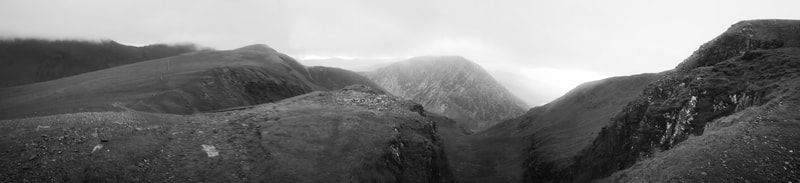
Not long ago I was in the mountains alone, travelling light with just a bivouac for shelter. The weather was poor and then got worse. Deep in cloud, my senses tuned into every shape and form in the landscape to find the best way through. I was in a deep state of listening, listening to myself and the wider environment, the landscape, the strength of the wind, judging the steepness of the ground, assessing risk, appreciating the security of a handhold or the presence of an animal track when there was one, taking care when there wasn’t. Safely navigating meant accepting my vulnerability and through it dealing more honestly with each situation, not battling with, but blending with the natural world, remaining humble, open to the possibility I might be wrong, willing to retrace my steps and set a new direction. It was a process of constantly checking my assumptions, expectations and hopes with the reality around me right now.
My plans to sleep out under the stars had been transformed over the previous hour into a search for shelter, somewhere out of the prevailing wind and horizontal rain. I began to examine more closely the inclination of exposed rocks as potential protection from the wind and rain, the slope of the ground and how the water drained as a suitable resting place. Now, everything about the landscape took on a particular importance and I smiled at how my intention had changed my relationship to my surroundings - now I was no longer passing through, and a deeper integration was dawning.
I found a small sheltered spot, just big enough to lie down where sheep had levelled the ground and grazed the vegetation creating a more comfortable base for sleeping. With the promise of rest and a place to cook, I felt lifted with a sense of gratitude. The rapidly fading light added a simplicity to the priorities at hand, to eat, create shelter, get warm and then sleep. Everything I did was in tune with the immediate surroundings, none of it perfect but together it was enough and that was good.
Wilder places always present an environment that is both teacher and therapist. A rapid change in weather, unexpected barriers to progress, the need to reassess and change direction, to swallow our pride and accept we’re not where we thought we were and how good it feels when we find our path again. Wilder places make our connection and interdependency with the natural world more obvious and immediate.
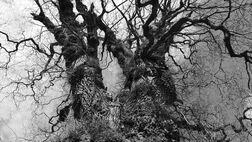
It’s not only in the wilder places that we can develop this sensitivity that sees our place as fitting into the natural world rather than dominating it. We can take time to listen to what nature has to teach us closer to home, whether it’s our local park, the dappled light through a tree lined street, looking up and gazing at the clouds and seeing the flight of birds, hearing the dawn chorus or exploring the local countryside. However we do it, one thing is in common - whether we enter a woodland or stroll across a park, we enter an ecosystem that is an interdependent and complex web of relationships and energetic transfer, an ecosystem that we are not just observing but we are part of. Our presence matters, what we do matters, how we do it matters. We do not pass unseen, without impact, without communicating.
Many indigenous peoples retain a deep reverence for the natural world, seeking to work with and not against it, seeing the health and wellbeing of the natural world as inextricably tied into their own. They recognise that any ecosystem is always in the process of recovering from a state of past disturbance towards a state of equilibrium whether caused naturally or by human intervention and part of their role is to assist this process not frustrate it. The same process of recovery towards equilibrium is also acknowledged as an intrinsic part of the human condition as it is in the whole of the natural world. This humility sees no one part as more important than another - the web of interdependency is felt as inclusive and not seen as a hierarchy. This wisdom is naturally protective to sustain balance and life.
What does it take to change our perspective?
New perspectives come from experiencing the familiar in new ways. We’re used to thinking of our walks and hikes in nature in terms of our own health and wellbeing and the evidence shows that being immersed in nature brings many benefits – it supports our immunity, improves mood, enhances attention and cardiovascular health amongst others. In some sense we consume what nature has to offer for our own well-being.
Is it just about consumption? What about the exchange between us and the environment, what are the energetic transfers and connections and why do they matter?
We each have a unique response to these questions conditioned by our current state of mind, our experiential and emotional history and our capacity to listen. Being in nature, alone and in silence leads us to relate to our environment in a different way. We tune more deeply into our outer and inner senses and gradually become more sensitive to this energetic exchange. We discover the natural environment presents as a mirror for us to see more clearly - we can witness how all of nature, including ourselves, is in the same process of recovery from past disturbance toward equilibrium. In this way the natural world can act as both teacher and therapist to guide us, both individually and globally.
This guidance has all shades of subtlety.
On an individual level, when we immerse in a natural landscape that’s in balance and deeply listen, we will sense both our own imbalance and a direction of change. If we follow this, valuing the energetic exchange in both directions, greater alignment comes and we begin to see our place in the web and what’s possible. Increasingly we realise there’s no separation between us and nature, nature’s wellbeing is our wellbeing, there’s the felt experience of an energetic merging. It’s as if we are the trees, the birds, the flowing water, the wind. All is an expression of the four elements we share in common.
On a global level our impact on the natural world reflects the degree our own disturbances have pulled us out of balance. When nature is impoverished, far from balance and the web is under severe strain, it’s a reflection our societal attitudes are out of alignment. When nature thrives and the web is resilient and balanced then societies are as well. Nature constantly tells us about the well-being of the web and as we are inextricably part of this, it also tells us about our own well-being as a human species.
So what does it mean to walk in nature? Where we find ourselves today, both individually and collectively, means the answer is never more important or urgent.
And what of that night on the bare mountain? In the morning as I left, I turned back in thanks, only to find I was barely able to distinguish my benefactor, unremarkable as it was in its surroundings, special only in the relationship we’d had and the gratitude I’d felt: a landscape lesson in modesty, generosity and the transience of experience.
Many indigenous peoples retain a deep reverence for the natural world, seeking to work with and not against it, seeing the health and wellbeing of the natural world as inextricably tied into their own. They recognise that any ecosystem is always in the process of recovering from a state of past disturbance towards a state of equilibrium whether caused naturally or by human intervention and part of their role is to assist this process not frustrate it. The same process of recovery towards equilibrium is also acknowledged as an intrinsic part of the human condition as it is in the whole of the natural world. This humility sees no one part as more important than another - the web of interdependency is felt as inclusive and not seen as a hierarchy. This wisdom is naturally protective to sustain balance and life.
What does it take to change our perspective?
New perspectives come from experiencing the familiar in new ways. We’re used to thinking of our walks and hikes in nature in terms of our own health and wellbeing and the evidence shows that being immersed in nature brings many benefits – it supports our immunity, improves mood, enhances attention and cardiovascular health amongst others. In some sense we consume what nature has to offer for our own well-being.
Is it just about consumption? What about the exchange between us and the environment, what are the energetic transfers and connections and why do they matter?
We each have a unique response to these questions conditioned by our current state of mind, our experiential and emotional history and our capacity to listen. Being in nature, alone and in silence leads us to relate to our environment in a different way. We tune more deeply into our outer and inner senses and gradually become more sensitive to this energetic exchange. We discover the natural environment presents as a mirror for us to see more clearly - we can witness how all of nature, including ourselves, is in the same process of recovery from past disturbance toward equilibrium. In this way the natural world can act as both teacher and therapist to guide us, both individually and globally.
This guidance has all shades of subtlety.
On an individual level, when we immerse in a natural landscape that’s in balance and deeply listen, we will sense both our own imbalance and a direction of change. If we follow this, valuing the energetic exchange in both directions, greater alignment comes and we begin to see our place in the web and what’s possible. Increasingly we realise there’s no separation between us and nature, nature’s wellbeing is our wellbeing, there’s the felt experience of an energetic merging. It’s as if we are the trees, the birds, the flowing water, the wind. All is an expression of the four elements we share in common.
On a global level our impact on the natural world reflects the degree our own disturbances have pulled us out of balance. When nature is impoverished, far from balance and the web is under severe strain, it’s a reflection our societal attitudes are out of alignment. When nature thrives and the web is resilient and balanced then societies are as well. Nature constantly tells us about the well-being of the web and as we are inextricably part of this, it also tells us about our own well-being as a human species.
So what does it mean to walk in nature? Where we find ourselves today, both individually and collectively, means the answer is never more important or urgent.
And what of that night on the bare mountain? In the morning as I left, I turned back in thanks, only to find I was barely able to distinguish my benefactor, unremarkable as it was in its surroundings, special only in the relationship we’d had and the gratitude I’d felt: a landscape lesson in modesty, generosity and the transience of experience.
 RSS Feed